
Tanjore paintings
Tanjore paintings, also known as Thanjavur paintings, are a classical South Indian art form that originated in the town of Thanjavur (Tanjore) in Tamil Nadu during the 16th century under the rule of the Chola dynasty and later flourished during the Nayak and Maratha periods.
Key Features of Tanjore Paintings
-
Rich Colors and Gold Foil Work
-
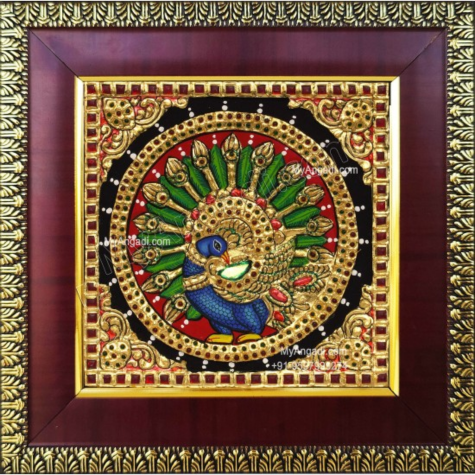
These paintings are known for their vivid colors, intricate designs, and the use of 24-carat gold foil, which gives them a royal and luminous appearance.
-
-
Religious and Mythological Themes
-
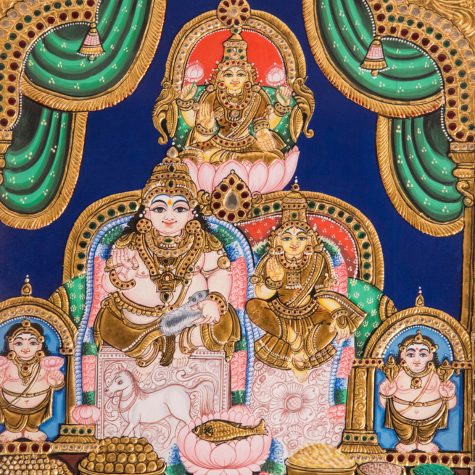
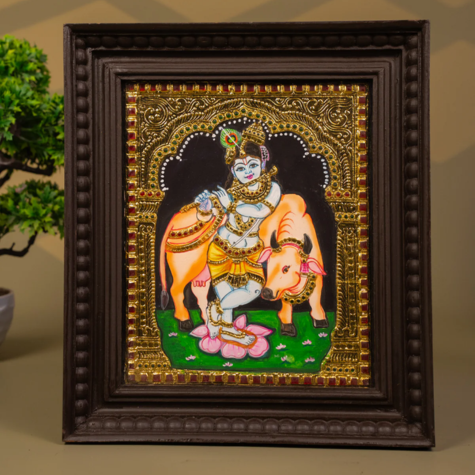
Tanjore paintings primarily depict Hindu gods and goddesses, with popular subjects including Lord Krishna, Lord Rama, Goddess Lakshmi, Lord Ganesha, and Lord Balaji.
-
Some paintings also portray episodes from Hindu epics like the Ramayana and Mahabharata.
-
-
Use of Precious Stones and Embellishments
-
Traditional Tanjore paintings include semi-precious stones, pearls, and glass pieces to enhance their grandeur.
-
-
Raised Relief Work (Gesso Work)
-
Artists create a 3D effect by using a mixture of chalk powder and glue for embossing key elements of the artwork.
-
-
Wooden Base (Panel Painting)
-
Unlike regular canvas paintings, Tanjore paintings are made on wooden planks (often teak or jackfruit wood), making them durable.
-
-
Traditional Composition
-
The central figure (usually a deity) is larger and more prominent, often framed within an ornate arch or temple-like structure.
-
The backgrounds are often filled with floral patterns, decorative borders, and ornamental designs.
-
Process of Making a Tanjore Painting
-
Preparing the Base
-
A wooden plank is coated with a mixture of chalk powder and gum, then smoothened.
-
-
Drawing the Sketch
-
The main figure and background are outlined using pencil or charcoal.
-
-
Gesso Work for Embossing
-
A paste made of chalk powder and Arabic gum is applied for embossing key parts.
-
-
Gold Foil and Stone Decoration
-
Gold leaf is applied over embossed areas, and stones are embedded.
-
-
Painting with Natural Colors
-
Natural dyes, vegetable colors, and mineral-based pigments are used for coloring.
-
-
Final Touch and Polishing
-
Once the painting is complete, it is polished and framed.
-
Phone
+91 98650 65190
deepa.jammi@gmail.com
Office
“Abhirami,” 2B, 2nd Floor,
Old No. 20, New No. 14, Dr. Nair Road,
T. Nagar, Chennai – 600017,
Tamil Nadu, India